
What Can AEO and GEO Tools Actually Measure?
Learn what AI visibility tools can observe, how sampled scores are calculated, and what to ask before comparing reports or buying a tool.
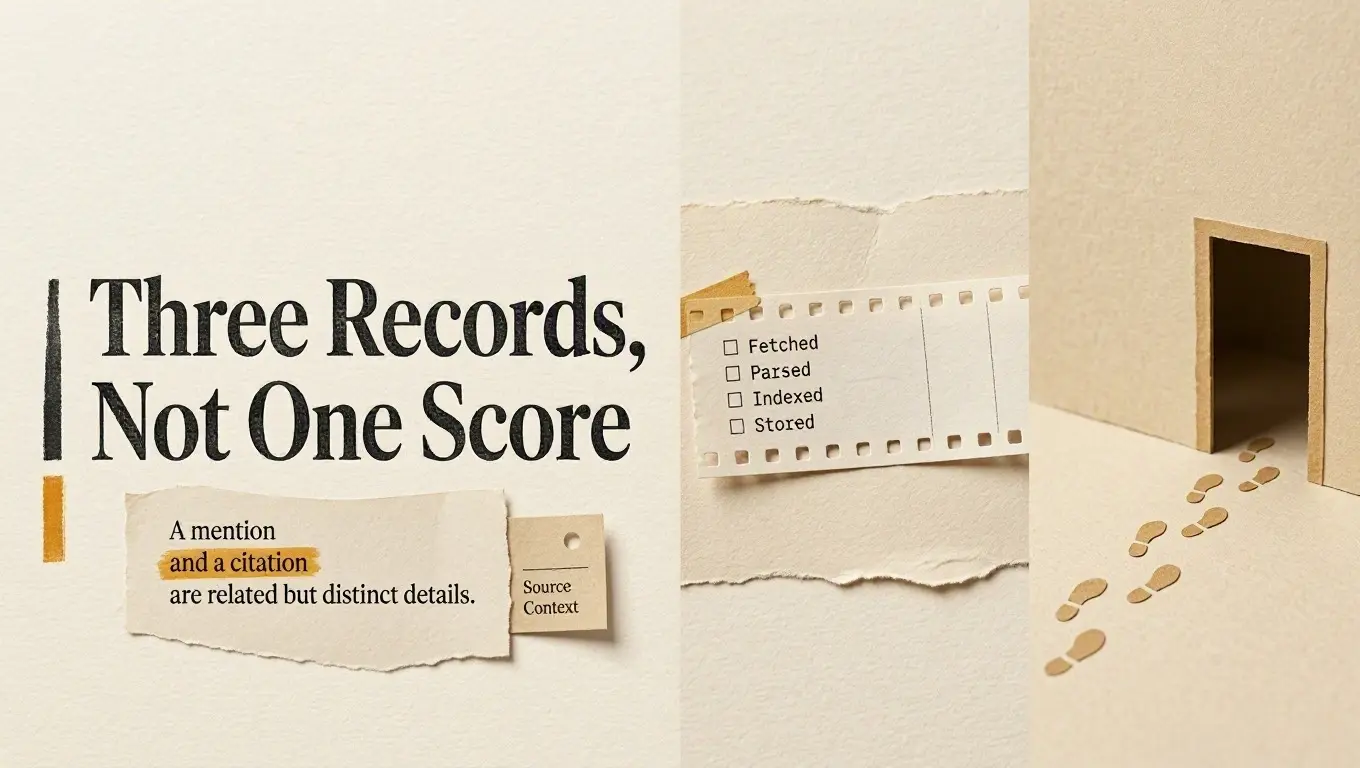
Before choosing an AEO or GEO tool, decide which question you need answered: What appears in AI answers today? Does that appearance change over time? Or do people arrive at your site and take action? A one-time check, repeatable answer monitoring and referral analysis require different records. A single visibility score cannot stand in for all three.
The AEO and GEO labels are less useful than the data behind a report. Tool comparisons distinguish monitoring from website auditing and optimization; those are different functions, even when a product offers them together. A content recommendation might be useful, but it is not itself a measurement of an appearance in an answer. That distinction appears in Scrunch’s comparison criteria and in Writesonic’s comparison of tracking and action workflows. These are the publishers’ descriptions of tool functions, not independent tests of measurement accuracy.
Match the question to the record
Saved answer captures can show whether a sampled answer mentions a publisher, links to one of its URLs, and describes the publisher accurately. The capture matters: it lets someone check whether a reported “citation” is a linked source, an unlinked brand mention or something else. Scrunch describes its own monitoring as collecting responses and identifying mentions, citations, placement and other attributes. That describes its method, not complete coverage of what every user sees.
Crawler or CDN logs can show visits by identified AI user agents, including which pages they requested and when. They do not, by themselves, show what an answer said. A visit associated with training or indexing should not be quietly relabeled as a retrieval for a particular answer. Scrunch describes bot monitoring separately from response monitoring and calls bot activity an upstream correlate of answer performance, rather than proof of it.
Web analytics can show identifiable referral visits and subsequent on-site actions, subject to what the site records and can attribute. An unlinked mention offers no link for a reader to follow; a linked citation creates a possible path, not evidence that anybody took it. The Buried Agency comparison makes this distinction when discussing unlinked mentions and GA4 conversion tracking. If outcomes are the buying question, ask what referral and conversion records the tool actually connects to its answer observations.
These records describe different stages. A bot visit does not establish inclusion in an answer. A mention need not link to the site. A citation does not establish a visit. And a referral or conversion occurring alongside a monitoring change does not prove that change caused the outcome.
What a sampled visibility score means
Imagine a hypothetical report that captures one answer for each of 40 prompts. Twelve answers mention a publisher; five cite its URL. The mention frequency is 12 ÷ 40 = 30% and the URL-citation frequency is 5 ÷ 40 = 12.5%, provided the report counts each answer once for each measure. Neither figure is the publisher’s share of all AI searches. Both describe this prompt set and these captures.
“Share of voice” needs its own definition. Is the denominator all captured answers, answers containing any brand, total brand mentions, or a selected group of competitors? Scrunch’s comparison defines it in terms of mentions versus competitors or third parties, but a buyer still needs the counting rule for the particular report. A score without that rule is hard to reproduce.
Prompt sourcing matters just as much. Were questions supplied by the publisher, adapted from search queries, or generated by a model? The Buried Agency review describes several prompt-discovery inputs for Promptwatch, including Search Console queries and AI-generated prompts. Writesonic’s comparison characterizes Promptwatch prompts differently. Rather than assume either description applies to the plan you are buying, request the actual prompt list and its sourcing method.
A one-time checker can provide a snapshot worth inspecting. An ongoing series using a fixed prompt list can show changes within that defined test. It cannot make the prompt list representative of every question readers ask. Nor is a change necessarily stable: Writesonic’s comparison reports variation across repeated AI answers, although it does not provide the underlying sample for its estimates. Save the captures, not just the chart.
Inspect the collection method before comparing tools
Ask a vendor for a sample export and check:
- Surface and conditions: Which named product and mode was captured—Google AI Overviews or AI Mode, for example? What were the locale and capture dates?
- Sampling: What is the complete prompt list, how was it sourced, how often is each prompt repeated, and were prompts added or removed?
- Evidence: Can you inspect each answer, its linked citations and the rule used to recognize an unlinked mention? How are missing or failed captures handled?
- Calculations: What exactly is the denominator for mention rate, citation rate and share of voice? Which competitors count?
- Collection and access: Was the answer collected through a live interface or an API? Do bot reports require CDN or log access, and do outcome reports require web-analytics access?
These are practical comparison questions, not a demand that every tool use the same method. The Buried Agency review, for instance, describes live-interface collection and a separate, plan-dependent crawler-log feature for Promptwatch. Such details affect what a quoted capability includes. Changing answer captures, prompt sets, modes or locales also make scores from two tools—or two dates—less directly comparable.
Do not substitute a nearby metric when the requested record is unavailable. Writesonic’s comparison notes that Search Console reports Google clicks, not a direct inventory of AI citations. Likewise, a low click-through rate is a reason to investigate what appears for relevant queries, not a citation record or proof that an AI Overview suppressed visits.
The working rule is simple: inspect saved answers for mentions and citations, logs for access, and analytics for identifiable visits and actions. Compare trends only when the prompt list, surface, locale, schedule and counting rules are documented and reasonably consistent. An unexplained score jump is a cue to open the underlying captures, not proof of a publisher-wide gain.